Comfortable Walking Shoes: 5 Sneaker‑Picking Tips for Diabetic Feet
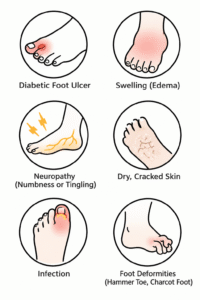
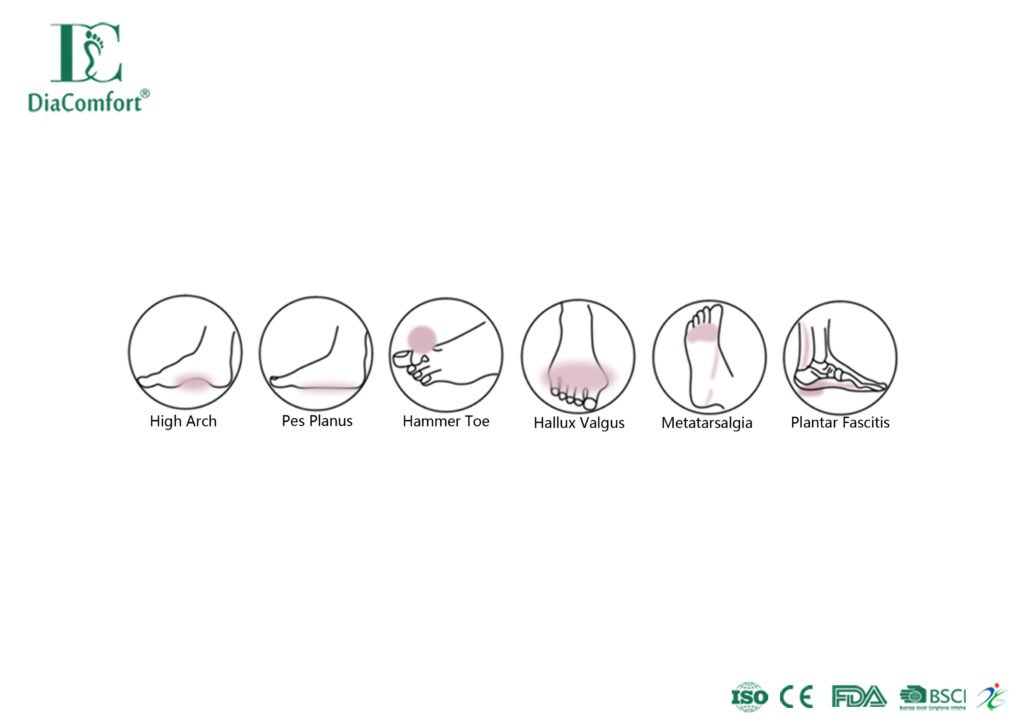
Comfortable Walking Shoes bear continuous body‑weight loads for users during daily‑life activities including grocery shopping, workplace commuting and casual outdoor walks, human feet sustain continuous body-weight loads throughout the whole day. A considerable number of middle-and-senior-age groups and individuals with hypersensitive foot tissues frequently suffer from pedal edema and plantar aching symptoms in the late afternoon. Foot disorders such as pes planus, high-arch deformity, hallux valgus and plantar fasciitis further create huge obstacles for daily footwear selection.
Conventional athletic footwear generally adopts cramped toe-box structures together with inferior air-permeability performance, which may easily trigger toe compression and epidermal friction injuries. For diabetic populations in particular, diminished tactile sensation occurs in foot regions; minor epidermal wounds on feet often require prolonged healing cycles. Well-fitted footwear with protective properties for foot physiology exerts a decisive influence on daily walking experience. This paper takes the DiaComfort DB506 therapeutic walking shoes as the research object, and summarizes five core selection principles of daily-use protective footwear for foot health.
1.Expansive Toe‑Box Structure for Non‑Compressive Toe Protection
Insufficient forefoot space represents a primary cause of footwear-related wearing discomfort. Long-term mechanical constriction may exert pressure on hallux valgus protrusions and hammer-toe deformities, which tends to induce toe erythema and aching pain after prolonged ambulation.
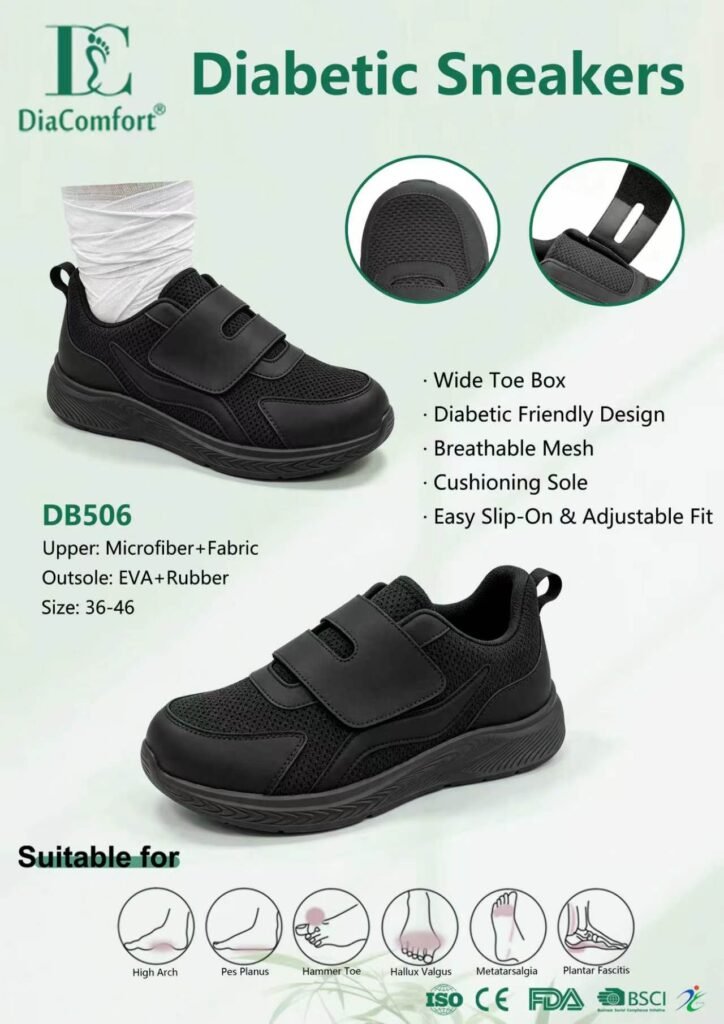
The DB506 therapeutic walking shoe adopts an enlarged inner forefoot compartment, reserving ample movable space for toe segments. Bony prominences and malformed toe structures are allowed natural extension without compressive force from the vamp. For diabetic patients accompanied by fragile pedal epidermis, this structural feature mitigates mechanical squeezing and frictional stimulation, decreasing the incidence of blister lesions and superficial skin trauma. Therefore, this footwear is applicable to multiple daily scenarios including indoor rest, grocery shopping and short-distance outdoor strolling.
2. Dual‑Adjustable Hook‑and‑Loop Fastener Construction for All‑Day Adaptive Wearing Performance
When purchasing Comfortable Walking Shoes, adjustable fastener design is critical for users suffering from afternoon foot swelling.
A prevalent footwear-related dilemma is observed among numerous users: footwear that delivers proper fitting in the early morning may generate oppressive discomfort around pedal margins as foot edema emerges in the late afternoon.
This shoe model is fitted with dual hook-and-loop fastening straps to realize flexible tightness modulation. For users presenting high-instep morphology or afternoon-onset pedal edema, strap tension can be calibrated to attain optimal looseness so as to avoid mechanical compression against dorsal foot blood vessels. Simplified donning-and-doffing operations eliminate the requirement for bending over to fasten shoelaces. Senior populations are capable of completing footwear wearing procedures effortlessly, and this configuration brings prominent convenience for individuals suffering from foot swelling.
3. Composite Vamp Constructed by Mesh Textile and Micro‑Fiber Material for Enhanced Ventilation Performance
Breathable upper construction is another vital feature of qualified Comfortable Walking Shoes.
Excessive perspiration and thermal accumulation inside footwear constitute major nuisances during daily ambulation. The humid-hot microenvironment formed within shoes brings sticky tactile discomfort, meanwhile it raises the risk of irritative reactions toward vulnerable pedal cutaneous tissue.
This footwear adopts compound vamp material integrating micro-fiber and permeable mesh textile. The material delivers supple surface texture, free from protruding coarse stitching seams that may cause scraping injury to foot epidermis. Smooth internal air circulation facilitates timely dissipation of pedal sweat. A dry inner-shoe microclimate can be maintained even under prolonged wearing conditions, which provides reliable wearing security for users with hypersensitive skin and diabetic populations suffering from fragile foot tissue.
4. EVA‑Rubber Hybrid Outsole Structure for Durable Support and Anti‑Fatigue Performance
High‑quality midsole components are the core guarantee for long‑wearing Comfortable Walking Shoes.
Plantar aching discomfort during ambulation is largely attributed to inadequate shock-absorbing capacity and deficient anti-skid properties of shoe outsoles.
This footwear incorporates a hybrid outsole integrating an EVA cushioning substrate and a rubber anti-slip base layer. In the course of human locomotion, the EVA component absorbs ground-produced impact energy, relieving compressive stress distributed across the plantar surface and heel region, so as to mitigate aching symptoms induced by plantar fasciitis. Anti-skid tread textures are distributed over the outsole surface, which stabilizes human gait upon wet ceramic tiles on rainy days and slippery outdoor ground, further lowering the possibility of slip-and-fall incidents. Benefiting from the overall lightweight construction of the shoe body, pedal fatigue can be effectively avoided even after extended continuous walking, delivering higher safety guarantees for elderly users during outdoor stroll activities.
5. Multi‑Dimensional Global Authorized Certifications to Reinforce Daily‑Use Reliability
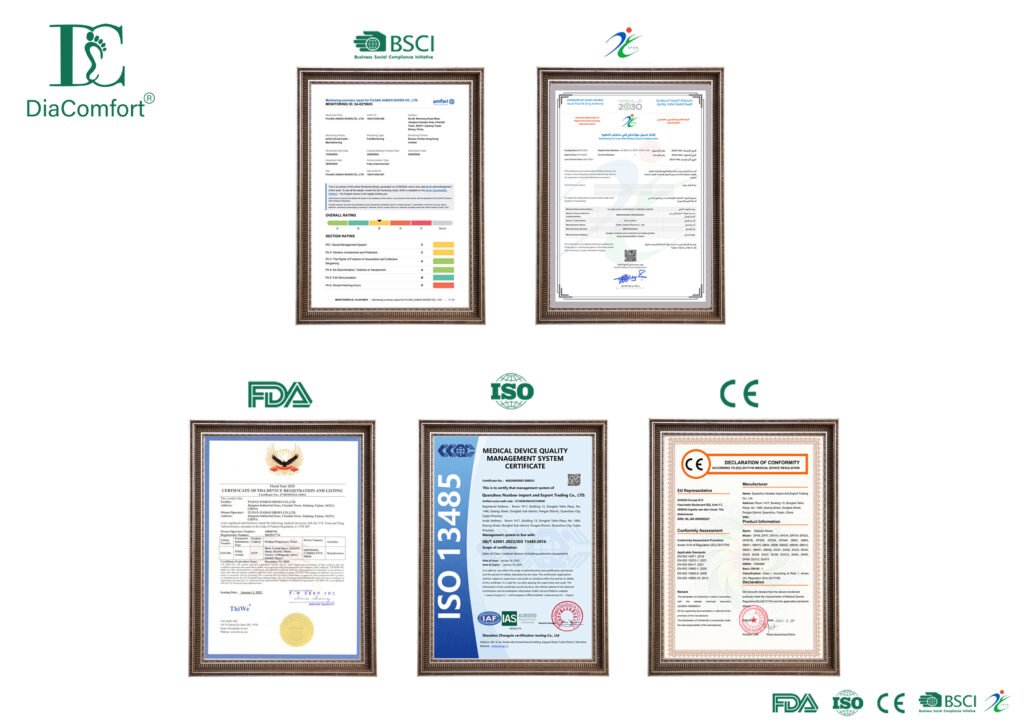
As a specialized therapeutic walking shoe oriented toward foot-health protection, the DB506 model has undergone multiple rounds of stringent laboratory assessments and acquired four globally-recognized official qualifications, which substantially improves consumer confidence during procurement:
✅ FDA Material-Safety Qualification: All textile components contacting human skin have passed rigorous safety evaluation, delivering effective protection for delicate and vulnerable pedal skin tissues;
✅ ISO Quality-Management System Certification: Standardized management is implemented throughout the whole manufacturing workflow, covering raw-material procurement to finished-product output, so consistent quality performance can be guaranteed for each footwear unit;
✅ EU CE Compliance Mark: The product satisfies European health-safety regulatory benchmarks, with its textile materials and manufacturing craftsmanship validated via multiple professional inspection procedures;
✅ BSCI Social-Compliance Certification: Manufacturing activities comply with international labor-protection and environmental-governance requirements, realizing full-traceability across the whole product lifecycle.
All these authoritative qualifications further guarantee the reliability of Comfortable Walking Shoes.
Available European shoe sizes range from 36 to 46. Benefiting from its wide-forefoot-box configuration, this footwear is applicable for both male and female end-users. You can browse more protective therapeutic footwear for reference.
For individuals troubled by plantar aching induced by prolonged standing, late afternoon pedal edema, or foot pathologies including diabetic foot complications, pes planus, high arch deformity, hallux valgus and plantar fasciitis, searching for footwear integrating wearing comfort and physiological protection for daily commuting and outdoor ambulation remains a real challenge. Under such circumstances, the DiaComfort DB506 therapeutic walking shoe serves as a viable alternative. For more material safety standards, please check APMA official website.
Users no longer need to compromise wearing experience merely for foot protective purposes. Characterized by spacious internal construction to avoid mechanical compression, soft material properties to prevent epidermal abrasion, as well as shock absorbing structures to reduce pedal fatigue, this footwear enables users to complete each gait cycle with minimal physical strain.