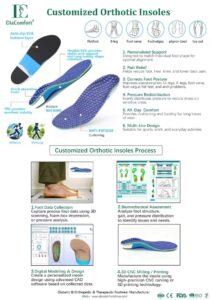
Many people experience foot fatigue and soreness when walking. They want to buy orthopedic Insoles but mistakenly believe that the softer the better. Choosing the wrong orthopedic Insoles not only fails to alleviate the discomfort but also increases the burden on the ankles and knees. Below are the key points for selecting the right insoles, allowing you to quickly find the ones that suit you.
Distinguish between two major types of foot shapes and choose the correct supporting logic
– Flat feet: Opt for shoes with a hard heel cup and a moderate arch support pad to stabilize the ankle and distribute the pressure on the sole, alleviating the discomfort caused by prolonged standing.
– High arches: Focus on cushioning the front and back of the foot, with gentle arch support, to reduce the concentrated pressure on the heel and the front of the foot.
Simple Self-Test: When stepping in wet footprints with bare feet, the inner side of the footprints has almost no curvature = flat feet; there is a large area of suspension in the middle = high arches.
Based on the Location of the Foot Pain, Adjust Your Orthopedic Insole Functions
– Heel pain (plantar fasciitis): Focus on the shock absorption and stability of the heel cushion
– Front foot pain: Choose a model with cushioning for the front part of the foot, but the thickness should not be too thick to avoid squeezing the shoe
– Persistent foot pain from standing: Support for the arch + overall rebound, rejecting soft sponge models that collapse immediately upon stepping
– Foot instability during walking: Strong rear heel stability structure, reducing inward and outward rotation of the foot
You can browse our full range in the custom orthopedic insoles product catalog.
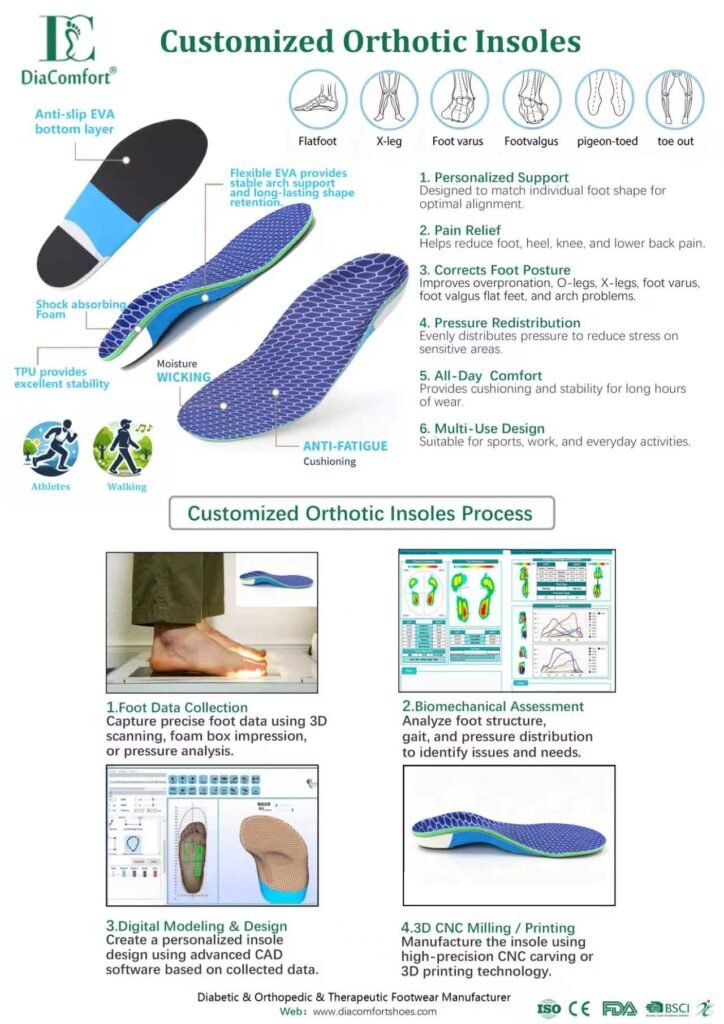
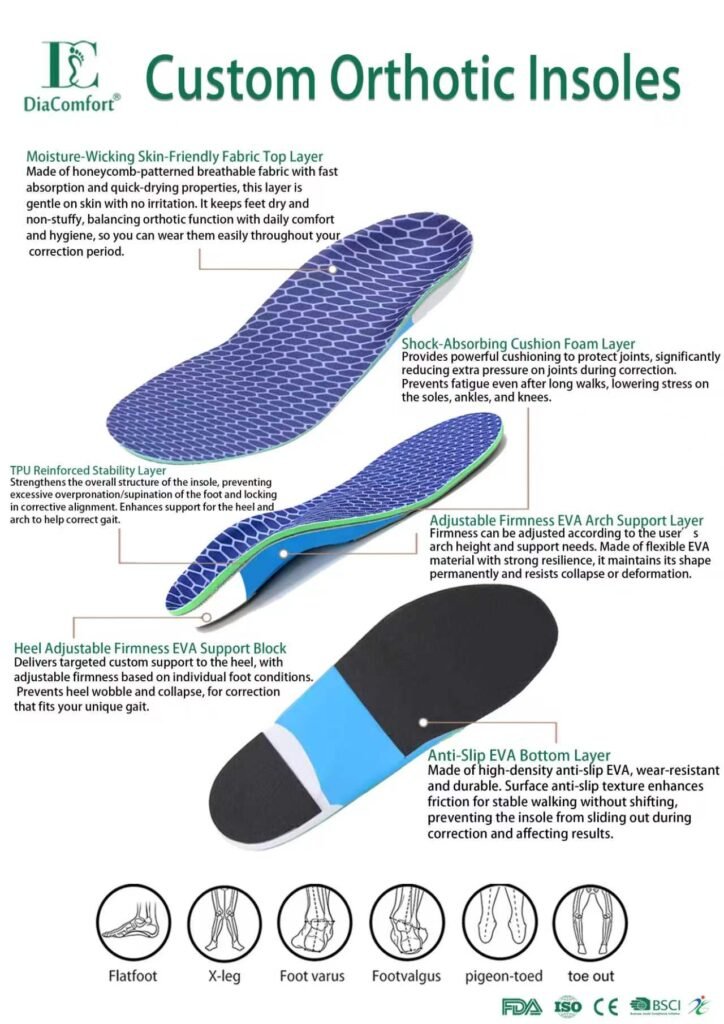
For a Pair of Qualified Orthopedic Insoles, Look for the Following 4 Features:
✅ The arch support protrudes, not a flat surface
✅ The hard heel cup fixes the heel and reduces shaking
✅ The heel and forefoot have cushioning layers to absorb landing impact
✅ The material is resilient and won’t collapse or deform over time
Our DiaComfort orthopedic Insoles have passed multiple strict performance tests and obtained internationally recognized certifications including FDA, ISO, CE and BSCI. Every production link from raw material selection to finished product delivery is under rigorous quality control.
- ✅ FDA Safety Certification: All materials touching human skin pass safety assessments to protect sensitive plantar skin
- ✅ ISO Quality Management System Certification: Standardized manufacturing procedures guarantee consistent quality for each pair of insoles
- ✅ CE European Certification: Products comply with EU health and safety specifications with materials and craftsmanship repeatedly inspected
- ✅ BSCI Social Responsibility Certification: Production follows global labor and environmental standards, supporting full product traceability
Select the thickness based on the shoe type
For athletic footwear, full-support standard variants with generous internal room are recommended. For leather footwear or narrow-fit shoes, low-profile insoles with mild arch support are preferred to prevent foot compression. For thong sandals and house slippers, only lightweight orthopedic Insoles with modest corrective functions are applicable, as their supporting performance remains constrained.
Criteria for Fitting Your Orthopedic Insoles
✔️ Suitable wearing feedback: Minor mild discomfort may occur in the initial adaptation stage without sharp pain. Plantar aching will be alleviated after long-distance walking, and the insert stays fixed without displacement.
❌ Unsuitable wearing feedback: Persistent arch ache, sustained soreness in calves and knees, or toe compression caused by the insert. Discontinue use right away.
Adaptation to new orthopedic Insoles should proceed step by step. Begin with 1 to 2 hours of daily wear and extend the wearing duration slowly.
Daily Maintenance Reminders for Your Orthopedic Insoles
Take out the orthopedic Insoles periodically and place them in well-aired dry environments to inhibit mould growth and unwanted odour accumulation.
Timely substitute worn, flattened or deformed orthopedic Insoles with new ones.
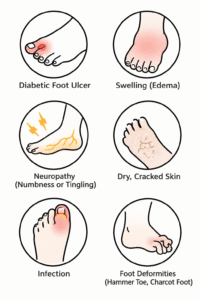
These inserts serve merely as auxiliary orthotic appliances and cannot substitute medical therapy. Individuals with diabetic foot lesions, chronic foot trauma or persistent foot discomfort ought to seek professional medical advice prior to use.
Summary
In the selection of orthopedic Insoles, high pricing or excessive softness should not be treated as the primary pursuit. The selection ought to match individual foot anatomy, pain sites and the inner space of footwear, together with considerations for supportive performance and shock absorption. Only by following these principles can foot fatigue induced by prolonged standing and walking be effectively eased.
For more professional foot health knowledge, you can visit the American Podiatric Medical Association (APMA) official website.